
Looking for a stable, respected career with good salary and growth? Bank jobs after graduation are among the most popular choices for young people in India and Kerala. Public sector banks, SBI, regional rural banks and other institutions recruit thousands of graduates every year through competitive exams. This 2026 guide explains the main bank jobs after graduation, eligibility, exam pattern, preparation strategy, salary and growth, and 7 easy steps to get selected.

Popular Bank Jobs After Graduation
| Exam / Post | Conducted by | Role |
|---|---|---|
| Probationary Officer (PO) | IBPS (for participating public sector banks), SBI | Officer cadre, future managers |
| Clerk / Customer Service Associate / Junior Associate | IBPS, SBI | Front office and operations |
| RRB Officer Scale I and Office Assistant | IBPS (for Regional Rural Banks) | Officer and clerical roles in rural banks |
| Specialist Officer (SO) | IBPS, SBI, individual banks | IT, law, HR, marketing, agriculture roles |
| RBI Assistant / Grade B | Reserve Bank of India | Central bank roles |
| Apprentice posts | Various banks | Training positions for graduates |
Eligibility for Bank Jobs After Graduation
- Education: A graduation degree in any discipline from a recognised university. Some specialist posts require specific degrees.
- Age: Generally 20 to 30 years for PO and 20 to 28 years for clerk posts, with relaxation for reserved categories as per rules. Check each notification.
- Language: For clerical posts, proficiency in the official language of the state you apply for (Malayalam for Kerala) is usually required.
- Computer literacy: Basic computer knowledge is expected.
- Nationality: Indian citizens and certain other categories as defined in notifications.
Exam Pattern Overview
Most bank jobs after graduation follow a multi-stage selection process:
- Preliminary exam: Online objective test with English, Quantitative Aptitude and Reasoning.
- Main exam: Deeper test with Reasoning and Computer Aptitude, Data Analysis, English, and General/Economy/Banking Awareness; PO mains often includes a descriptive English test.
- Interview: For PO and officer posts.
- Language proficiency test: For clerical posts in some cases.
Each section usually has sectional time limits, and wrong answers carry negative marking. Always read the latest notification for the exact pattern.
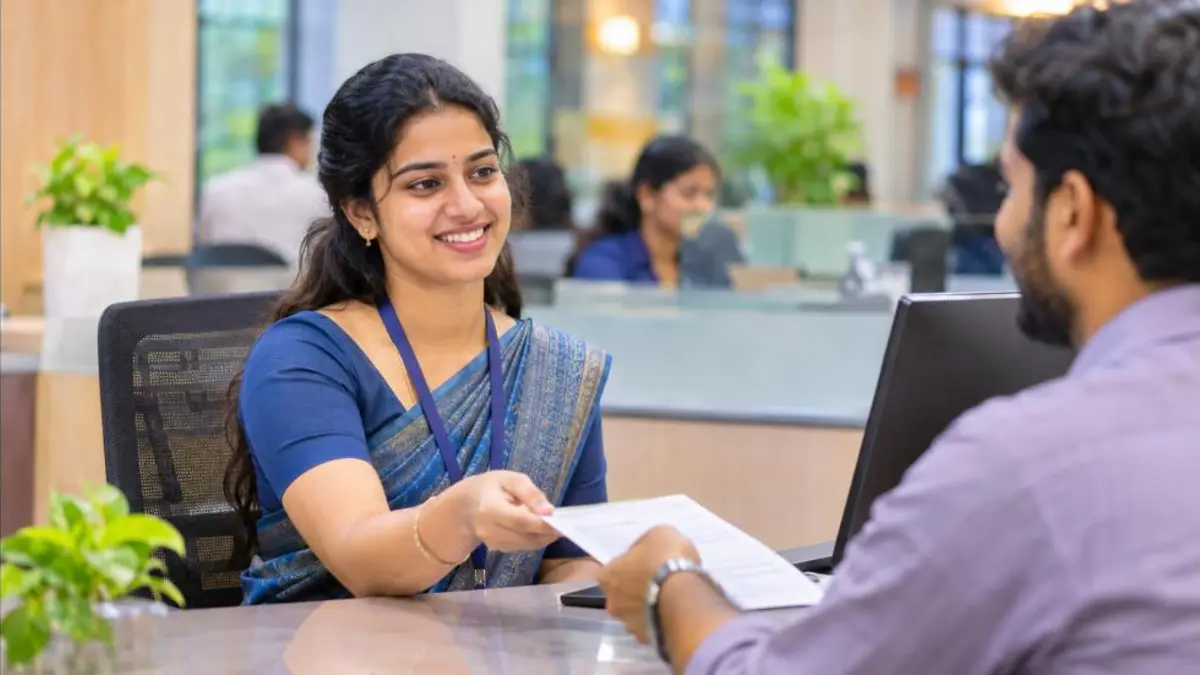
7 Easy Steps to Get Bank Jobs After Graduation
1. Choose Your Target Exams
Decide whether you want officer posts (PO, RRB Officer, SO) or clerical posts. Many candidates prepare for both, since the syllabus overlaps. Track notifications from IBPS, SBI and RBI regularly. See our IBPS recruitment updates for current openings.
2. Understand the Syllabus
Core areas for bank jobs after graduation include quantitative aptitude (simplification, number series, data interpretation, arithmetic), reasoning (puzzles, seating arrangement, syllogism, inequality, coding), English (reading comprehension, cloze test, error spotting) and general/banking awareness for mains.
3. Build Strong Basics
Start with basic maths concepts and simple reasoning patterns. Use standard books for quantitative aptitude and reasoning, and read English newspapers daily to improve comprehension and vocabulary.
4. Focus on Speed and Accuracy
Bank exams are known for tough time limits. Practise sectional tests with a timer. Learn calculation tricks, squares, cubes and percentage-fraction conversions to save time.
5. Take Regular Mock Tests
Full-length online mocks are essential. Attempt them in exam-like conditions, analyse every mistake, and track your scores. Aim to improve both attempts and accuracy each week.
6. Prepare Banking Awareness
Read about RBI policies, banking terms, financial inclusion schemes, recent mergers and current economic news. Monthly current affairs PDFs and banking awareness capsules help in mains.
7. Prepare for Interview and Documents
For PO posts, practise interview questions about yourself, your graduation subject, banking basics and current affairs. Keep certificates, caste/EWS certificates and ID proofs ready in the required formats for document verification.
Salary and Benefits
Bank jobs after graduation offer attractive pay as per the bank industry wage settlements, along with dearness allowance, house rent allowance or leased accommodation, medical benefits, leave travel concession and pension (NPS) benefits. Officers also get faster promotions through internal exams. Exact salary depends on the post, location and wage revisions, so refer to the official notification for current figures.
Career Growth
A PO typically starts as an Assistant Manager (Junior Management Grade Scale I) and can rise to Manager, Senior Manager, Chief Manager and higher through promotion exams and performance. Clerks can also become officers through internal promotion exams. Bank jobs after graduation thus offer a clear, long-term career path.

Study Plan for Bank Exams
| Phase | Duration | Focus |
|---|---|---|
| Foundation | Month 1–2 | Basic maths, reasoning concepts, grammar, reading habit |
| Practice | Month 3–4 | Topic-wise practice, sectional tests, data interpretation, puzzles |
| Mock phase | Month 5 onwards | Full mock tests, analysis, banking awareness, current affairs |
Daily, aim for two to four hours if you are working, and five to six hours if you are a full-time aspirant. Keep one day a week for revision and a full mock test.
Tips for Kerala Candidates
- Choose Kerala as the state preference for clerical posts if you are comfortable with Malayalam, since local language proficiency is required.
- Kerala has a large number of public sector and private bank branches, so clerical vacancies are regular.
- Cooperative banks and Kerala Bank also recruit through Kerala PSC and other processes; keep track of those notifications too.
- Join local study groups or online communities of bank aspirants for motivation and resources.
Common Mistakes to Avoid
- Ignoring sectional cut-offs: You must clear each section, not just the overall score.
- Over-attempting with low accuracy: Negative marking can pull your score down.
- Skipping English: Many candidates lose out due to weak English.
- Not reading the notification carefully: Age, qualifications and dates differ between exams.
- Late applications: Websites slow down near the last date; apply early.
Other Banking Career Options
Apart from PO and clerk exams, graduates can explore bank apprentice programmes, private bank hiring through campus and online drives, banking operations roles in NBFCs and fintech companies, and insurance sector exams. Apprenticeships give practical banking experience and a stipend; see our Indian Bank apprentice guide.
PO vs Clerk: Which Should You Choose?
| Point | Probationary Officer | Clerk |
|---|---|---|
| Cadre | Officer | Clerical (award staff) |
| Selection | Prelims, mains, interview | Prelims, mains (no interview in most cases) |
| Work | Supervision, loans, management, customer relations | Cash, deposits, customer service, data entry |
| Transfers | All-India transfers likely | Usually within the state |
| Growth | Faster promotions to senior management | Can become officer through internal exams |
Both are excellent bank jobs after graduation. If you prefer staying close to home, the clerk route offers stability within Kerala; if you want leadership roles and are open to relocation, PO is the better choice.
Regional Rural Bank Jobs
Regional Rural Banks (RRBs) serve rural areas and recruit Officers Scale I, II, III and Office Assistants (Multipurpose) through IBPS. Kerala has its own regional rural bank serving the state. RRB recruitment is a great option among bank jobs after graduation, especially for candidates who know the local language and want to work in their home region. The exam pattern is similar to PO and clerk exams, with an interview for officer posts.
SBI vs IBPS Exams
SBI conducts its own recruitment for PO and Junior Associates, separate from IBPS. The syllabus is largely similar, but SBI exams are often considered slightly tougher, with different section patterns and a group exercise or interview for PO. Many candidates prepare for both together, as one strong preparation covers most topics needed for bank jobs after graduation across institutions.
A Day in the Life of a Bank Officer
A typical day for a new officer starts before the branch opens, with checking cash positions, reviewing pending tasks and planning customer meetings. During the day, officers handle account openings, loan processing, customer complaints, compliance checks and coordination with the regional office. In rural branches, officers also work on government schemes like Jan Dhan, Mudra loans and crop loans. The work can be demanding, but it offers rich experience in finance, people management and public service.
Tips for Final-Year Students
If you are in the final year of graduation, you can start preparing now. Many bank exams allow final-year students to apply if they complete graduation by the specified date; check each notification. Use college time to build maths and reasoning basics, improve English and develop the reading habit. Starting early gives you a big advantage when the first notifications for bank jobs after graduation arrive after you finish college.
Section-Wise Preparation Strategy
Quantitative Aptitude
Quantitative aptitude is often the toughest section for candidates seeking bank jobs after graduation. Begin with simplification and approximation, which appear in large numbers in prelims. Then cover number series, quadratic equations and arithmetic topics such as percentage, profit and loss, simple and compound interest, ratio, partnership, time and work, speed and distance, and mixtures. Data interpretation (tables, bar graphs, pie charts and caselets) carries heavy weight in mains, so practise one DI set every day.
Reasoning Ability
Puzzles and seating arrangements form the core of reasoning for bank jobs after graduation. Practise linear, circular and box-based puzzles, floor puzzles and scheduling. Other topics include syllogism, inequality, coding-decoding, blood relations, direction sense, order and ranking, and input-output. Speed comes from solving many puzzles of different types.
English Language
Reading comprehension is the most important part. Read editorials daily and summarise them in your own words. Practise cloze tests, error detection, sentence rearrangement, fillers and word usage. For PO mains, practise essay and letter writing within the time limit.
General and Banking Awareness
For mains, cover current affairs of the last six months, banking terms, RBI functions, monetary policy basics, government schemes, financial institutions and static GK like headquarters and taglines of banks. Short daily reading is better than last-minute cramming.
Computer Aptitude
Many bank exams include computer awareness or computer aptitude. Learn basics of hardware, software, operating systems, MS Office, internet, networking and cybersecurity terms.
Bank Jobs After Graduation: Online vs Offline Coaching
Online coaching offers flexibility, recorded classes and affordable test series, which suits working candidates and those in rural areas. Offline coaching gives a classroom environment, discipline and peer motivation. Many successful candidates combine self-study with an online test series. Whichever you choose, regular mock tests and analysis are what truly prepare you for bank jobs after graduation.
How to Handle Exam Pressure
Bank exams can be stressful because of tight time limits and high competition. Practise breathing techniques before mocks, keep a fixed sleep schedule, and avoid comparing your progress with others. Remember that most selected candidates for bank jobs after graduation did not clear on their first attempt; they learned from each exam and improved steadily.
Document Checklist
- Graduation mark sheets and degree certificate
- Date of birth proof (SSLC certificate)
- Caste, EWS or non-creamy layer certificate, if applicable
- Disability certificate, if applicable
- Photo ID such as Aadhaar or passport
- Recent photographs and signature scans as per specifications
- Experience certificates, if any
Weekly Routine for Bank Aspirants
- Monday and Thursday: Quantitative aptitude topics and two DI sets.
- Tuesday and Friday: Reasoning puzzles, seating arrangements and miscellaneous topics.
- Wednesday: English reading comprehension, cloze tests and vocabulary.
- Saturday: Banking awareness, current affairs and computer basics.
- Sunday: One full-length mock test and detailed analysis.
This routine covers every section each week while leaving room for revision. Adjust hours based on your strengths and weaknesses, but keep the weekly mock test fixed. Over a few months, this steady rhythm builds the speed and accuracy needed to clear the cut-offs for bank jobs after graduation.
Success Story: From Graduate to Bank Officer
Aswathy, a B.Sc. Mathematics graduate from Kollam, started preparing for bank jobs after graduation while working part-time as a tuition teacher. She studied three hours every evening, joined an online test series and wrote a mock test every Sunday. In her first attempt she cleared the clerk prelims but missed the mains cut-off by a few marks. She analysed her weak areas, especially English and data interpretation, and worked on them for the next six months.
In the next cycle, she cleared both the clerk and PO exams. She chose the PO post and now works as an Assistant Manager in a public sector bank. Her advice to new aspirants is simple: be consistent, analyse every mock test honestly and never give up after one failure. Stories like hers show that bank jobs after graduation are achievable with discipline and smart preparation.
Another useful habit is maintaining an error log. After every mock test, list the questions you got wrong, note the reason (concept gap, calculation mistake, misreading or time pressure) and write the correct method. Review this log every weekend. Within a few weeks you will see patterns, such as repeated mistakes in percentage problems or comprehension inference questions, and you can target them directly. This turns every mock test into a learning opportunity instead of just a score, and it steadily lifts both accuracy and confidence before the real exam day arrives.
Frequently Asked Questions
Which is the best bank job after graduation?
PO posts offer higher pay and faster growth, while clerk posts offer stability and local postings. Choose based on your goals and preferences.
Can I get bank jobs after graduation with any degree?
Yes. Most PO and clerk posts accept graduates from any discipline. Some specialist posts need specific degrees.
How long does preparation take?
With focused effort, many candidates need six months to a year. It depends on your basics and consistency.
Is there negative marking?
Yes, usually a fraction of the marks for each wrong answer. Check the notification for exact details.
Do I need Malayalam for bank clerk jobs in Kerala?
Generally yes. Proficiency in the official language of the state is required for clerical posts.
Conclusion
Bank jobs after graduation offer security, good pay and clear career growth. Choose your target exams, understand the syllabus, build strong basics, practise with mock tests and keep up with banking awareness. With smart planning and steady effort, you can secure one of the many bank jobs after graduation announced every year by IBPS, SBI, RBI and other institutions.
Note: Eligibility, age limits and exam patterns are decided by recruiting bodies and may change. Always check the official IBPS website and bank notifications before applying.